
 Google Calendar
  Outlook Calendar
  Google Meet
  Microsoft Teams
  Zoom Meetings
 Best Apps to View All Calendars in One Place (2025 Review)
Compare the top apps for viewing all calendars in one place. Detailed reviews of features, limits, and pricing to help you choose the right solution.
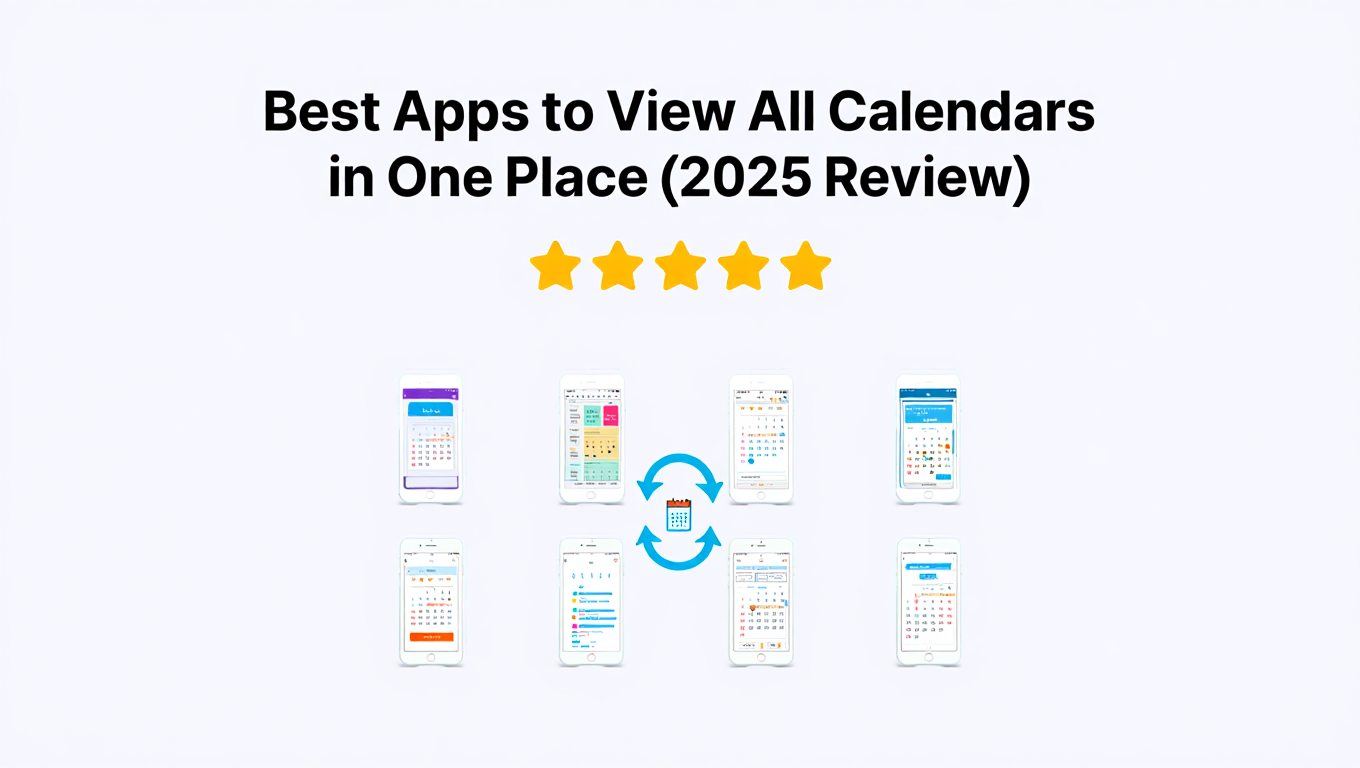
Switching between Google Calendar, Outlook, Apple Calendar, and three different team scheduling tools just to figure out if you are free Thursday afternoon is not a productivity system. It is chaos with a digital veneer.
According to 2024 workplace research, professionals spend an average of 6 hours per week on scheduling-related activities, with much of that time wasted toggling between disconnected calendar platforms. The solution exists in apps specifically designed to show all calendars in one place, but choosing the right one requires understanding their fundamental differences.
Not all calendar consolidation apps are created equal. Some impose strict limits on how many calendars you can connect. Others require technical expertise to configure. Many prioritize scheduling features over actual calendar management. This comprehensive review examines the leading apps for viewing all calendars in one place, comparing features, limitations, and real-world usability.
- Analyzed 12 leading calendar consolidation platforms based on 2024-2025 features
- Tested calendar connection processes, synchronization reliability, and mobile experiences
- Evaluated pricing structures, calendar limits, and hidden restrictions
- Compared interfaces for power users managing 10+ calendars versus casual users
- Verified claims through hands-on testing and current user feedback
What Makes a Great Calendar Consolidation App?
Before diving into specific app reviews, understanding evaluation criteria helps you assess which solution matches your needs.
Unlimited or Generous Calendar Connections
The most critical feature is how many calendars the app actually lets you connect. Apps claiming to show all calendars in one place while limiting you to 4 or 6 connections fundamentally misunderstand power user requirements. Professionals managing multiple roles, clients, or responsibilities easily require 10-15+ calendar connections for complete visibility. Learn more about strategies to manage 5+ calendars effectively.
True Unified View, Not Just Side-by-Side Display
Some apps simply show multiple calendars in adjacent columns. Better solutions create genuinely unified views that intelligently merge events from all sources into a single master timeline. The best apps support both approaches, letting you toggle between unified timelines and source-separated views based on current needs.
Reliable Real-Time Synchronization
Calendar consolidation only works when your unified view stays current. Apps using hourly sync intervals create dangerous gaps where recent schedule changes do not appear in your consolidated view. Look for platforms offering real-time or near-real-time synchronization through webhook architectures rather than periodic polling.
Cross-Platform Availability
You check calendars on desktop during planning sessions and on mobile while traveling. Great calendar apps deliver equivalent functionality across platforms. Many apps compromise mobile experiences with stripped-down interfaces or missing features that undermine their usefulness.
Calendar-First Design Philosophy
Distinguish between scheduling tools that happen to aggregate calendars and calendar management platforms designed specifically for consolidation. This design philosophy difference dramatically affects interface design, feature priorities, and overall user experience for anyone using calendars as their primary productivity tool.
Comprehensive App Reviews for All Calendars in One Place
CalendHub.com
Best For: Power users managing 10+ calendars who need unlimited connections without technical complexity
CalendHub positions itself specifically as a calendar-first platform rather than a scheduling tool that happens to show multiple calendars. This fundamental design philosophy makes it the strongest option for professionals who need to truly see all calendars in one place.
Calendar Connection Limits: Unlimited across all plans. Whether you manage 5 calendars or 50, CalendHub accommodates your complete ecosystem without arbitrary restrictions.
Supported Calendar Types: Google Calendar, Microsoft Outlook, Office 365, Apple iCloud, Exchange, and any calendar supporting standard ICS feeds. The platform handles both OAuth authentication for major providers and internet calendar subscriptions for specialized sources.
Key Features:
- True unified dashboard consolidating all connected calendars into a master view
- Advanced filtering and calendar layering for context-specific visibility
- Zero-configuration setup that non-technical users navigate easily
- Real-time synchronization across all connected calendar sources
- Mobile apps with full feature parity to desktop experience
- Intelligent conflict detection across all calendar sources
- Customizable color coding and visual organization tools
Pricing: Transparent pricing without per-calendar charges or hidden limitations. Designed for professionals who refuse to compromise calendar visibility due to artificial platform restrictions.
Strengths: CalendHub excels at supporting power users with extensive calendar ecosystems. The unlimited calendar connections, combined with sophisticated filtering and layering capabilities, make it viable for professionals managing complex scheduling requirements across multiple roles, clients, or organizations. The calendar-first design philosophy means every feature prioritizes calendar management rather than treating it as secondary to scheduling.
Limitations: Users seeking primarily appointment scheduling features rather than comprehensive calendar management might find scheduling-first platforms more aligned with their needs.
Verdict: For professionals who need to consolidate 8, 10, 15, or 20+ calendars into a genuinely unified view, CalendHub provides the most capable solution. The unlimited connection approach combined with accessible implementation makes it the top choice for serious calendar consolidation.
OneCal
Best For: Users wanting straightforward calendar synchronization between Google, Outlook, and iCloud
OneCal focuses specifically on syncing calendars across the major providers, keeping multiple calendar sources in continuous synchronization rather than just displaying them together.
Calendar Connection Limits: No advertised limit on the number of calendars you can view simultaneously. OneCal emphasizes unlimited calendar viewing as a core feature.
Supported Calendar Types: Google Calendar, Microsoft Outlook, and Apple iCloud Calendar. The platform specializes in these three major providers rather than supporting broader calendar ecosystem sources.
Key Features:
- Calendar View feature for seeing all calendars in one place
- Two-way synchronization that keeps calendars updated across all sources
- Ability to hide sync-created calendar clones for cleaner unified views
- Quick meeting join functionality from the unified calendar view
- Real-time conflict detection across synced calendars
Pricing: Subscription model with different tiers based on features. The Calendar View feature availability depends on your plan level.
Strengths: OneCal's two-way synchronization approach means events created in one calendar automatically appear in all synced calendars, not just in a unified view. This synchronization strategy works well for users who need calendar consistency across multiple devices or platforms.
Limitations: The platform focuses exclusively on Google, Outlook, and iCloud. If you use other calendar sources like Exchange, ICS feeds, or embedded calendars in project management tools, OneCal cannot incorporate them into your unified view. The synchronization-first approach also means your actual calendar sources contain duplicate events, which some users find cluttered.
Verdict: Solid choice for users whose calendar ecosystem consists entirely of Google, Outlook, and iCloud calendars. The synchronization approach offers benefits beyond simple unified views but becomes limiting for users with diverse calendar sources.
CalendarBridge
Best For: Users needing unified calendar management with strong ICS feed support
CalendarBridge takes a unified calendar approach that combines calendars from multiple sources into a single interface similar to Google Calendar or Outlook, but with enhanced cross-platform capabilities.
Calendar Connection Limits: The Unified Calendar feature displays all connected calendars without advertised limits. However, scheduling pages natively support checking availability on up to 4 calendars, which might constrain certain use cases.
Supported Calendar Types: Google Calendar, Microsoft 365, Outlook, iCloud, and internet calendars using ICS URLs. The strong ICS support makes CalendarBridge particularly valuable for incorporating calendar feeds from specialized sources.
Key Features:
- Unified Calendar interface consolidating all connected calendars
- Real-time refresh including ICS feeds and shared calendars
- View, edit, and manage every connected calendar from one interface
- Support for internet calendars via ICS URLs alongside major providers
- Shared calendar integration with live updates
Pricing: Subscription tiers with different feature access levels. Unified Calendar functionality available on paid plans.
Strengths: The robust ICS feed support distinguishes CalendarBridge from competitors focusing exclusively on major calendar providers. If your calendar ecosystem includes event calendars, team resource calendars, or specialized scheduling tools that publish ICS feeds, CalendarBridge incorporates them alongside your standard calendars.
Limitations: The 4-calendar limit for availability checking on scheduling pages creates a disconnect between the unified view and scheduling functionality. While you can view more calendars, using them for scheduling purposes encounters restrictions.
Verdict: Strong option for users with diverse calendar sources, particularly those needing to incorporate ICS calendar feeds. The unified interface works well, though the scheduling limitations might frustrate users needing comprehensive availability checking.
Morgen
Best For: Users wanting integrated calendar and task management in one comprehensive productivity hub
Morgen goes beyond simple calendar consolidation by combining calendar management, task tracking, and time blocking into a unified productivity platform.
Calendar Connection Limits: Connects calendars from Google, Outlook, Apple, Fastmail, and additional providers without advertised limits.
Supported Calendar Types: Google Calendar, Microsoft Outlook, Apple Calendar, Fastmail, plus integration with popular task management platforms.
Key Features:
- Consolidated view of multiple calendars in one app
- Integrated task management alongside calendar events
- Time blocking capabilities across all connected calendars
- Customizable shortcuts for viewing calendar subsets
- Available for Windows, Mac, Linux, and mobile platforms
Pricing: Freemium model with basic calendar consolidation free and advanced features requiring subscription.
Strengths: The integrated approach combining calendars, tasks, and time blocking creates a comprehensive productivity system. Users who want unified task and calendar management rather than just calendar consolidation benefit from Morgen's broader feature set. The cross-platform availability including Linux support reaches users underserved by many calendar apps.
Limitations: The additional productivity features add interface complexity that pure calendar consolidation users might find unnecessary. The learning curve exceeds simpler calendar aggregation tools focused exclusively on unified calendar views.
Verdict: Excellent choice for users wanting comprehensive productivity integration. The calendar consolidation features work well, but the platform's true value emerges when you leverage the task management and time blocking capabilities alongside calendar unification.
Spike Calendar
Best For: Users managing calendars across multiple email providers who want calendar integration with their email workflow
Spike integrates calendar management directly into its email platform, allowing you to manage all your calendars alongside your email communications.
Calendar Connection Limits: Connects all your calendars from every email provider you use with Spike.
Supported Calendar Types: Calendars associated with any email provider Spike supports, creating unified calendar views across multiple email-based calendars.
Key Features:
- View all calendars together from every email provider
- Integrated email and calendar management in one interface
- Unified schedule view combining work meetings and personal events
- Calendar management directly from your email inbox
Pricing: Included with Spike email platform subscription.
Strengths: The email integration approach makes sense for users who live primarily in their email inbox. Managing calendars alongside email eliminates context switching between separate calendar and email applications. All email-associated calendars consolidate automatically when you connect email accounts.
Limitations: Requires adopting Spike as your email platform, not just a calendar tool. Users happy with their current email clients face a significant switching cost. Calendar consolidation remains limited to email-provider calendars, potentially missing standalone calendar sources.
Verdict: Valuable for users willing to adopt Spike as their primary email platform. The calendar consolidation works well within that ecosystem but requires commitment to the broader Spike environment rather than functioning as a standalone calendar solution.
Google Calendar (Native Multi-Calendar View)
Best For: Users whose entire calendar ecosystem consists of Google Calendars
While not typically considered a calendar consolidation app, Google Calendar's native ability to display multiple Google Calendars simultaneously deserves evaluation for users fully committed to the Google ecosystem.
Calendar Connection Limits: Unlimited Google Calendars. You can view dozens of Google Calendars simultaneously if needed.
Supported Calendar Types: Google Calendars exclusively. You can subscribe to ICS feeds, importing them as Google Calendar sources, but native support remains limited to Google's ecosystem.
Key Features:
- Toggle individual calendar visibility for customized views
- Color coding and naming for easy calendar differentiation
- Familiar interface that billions of users already understand
- Seamless integration across web, Android, and iOS
- Shared calendar support with granular permission controls
Pricing: Free for personal use. Google Workspace subscriptions include enhanced calendar features for business users.
Strengths: If you already use Google Calendar and can consolidate all your calendar sources into Google's ecosystem, the native multi-calendar view requires no additional apps or subscriptions. The interface familiarity reduces learning curves to zero. Performance and reliability benefit from Google's infrastructure.
Limitations: Only works for Google Calendars. If you need to view Outlook calendars, iCloud calendars, or other non-Google sources alongside Google Calendars, the native interface cannot accommodate them. You must either sync everything into Google Calendar (creating duplicate events and synchronization dependencies) or use a true multi-platform consolidation app.
Verdict: Perfectly adequate for Google-only calendar ecosystems. Completely inadequate for anyone needing true cross-platform calendar consolidation. Most professionals managing calendars across Google, Outlook, and other sources quickly hit the limitations of Google Calendar's native capabilities.
Microsoft Outlook (Multi-Calendar Display)
Best For: Users operating primarily within the Microsoft 365 ecosystem
Like Google Calendar, Microsoft Outlook offers native multi-calendar viewing within its ecosystem, supporting multiple Outlook, Exchange, and connected calendar sources.
Calendar Connection Limits: Can display multiple calendars simultaneously, with practical limits based on screen real estate rather than technical restrictions.
Supported Calendar Types: Microsoft Exchange, Outlook.com, Office 365, plus subscribed internet calendars via ICS feeds. Can also connect Google Calendar through subscription mechanisms.
Key Features:
- Side-by-side and overlay calendar viewing modes
- Calendar groups for organizing related calendar sets
- Shared calendar access within Microsoft 365 organizations
- Integration with Teams for meeting scheduling
- Color coding and categorization across calendars
Pricing: Included with Microsoft 365 subscriptions. Standalone Outlook available on various plans.
Strengths: Users committed to Microsoft's ecosystem get robust multi-calendar functionality without additional tools. The integration with Teams, SharePoint, and other Microsoft productivity tools creates a cohesive environment. Enterprise users benefit from Active Directory integration and organizational calendar features.
Limitations: Cross-platform calendar consolidation proves challenging. While you can subscribe to Google Calendar via ICS feeds, this creates read-only, periodically updated copies rather than true two-way integration. The calendar interface optimizes for Microsoft calendar sources, making hybrid ecosystems awkward.
Need better calendar management? CalendHub unifies all your calendars with smart scheduling and video conferencing.
Verdict: Strong solution for Microsoft-centric organizations and users. Inadequate for professionals needing equal-priority access to calendars across Google, Apple, and Microsoft platforms simultaneously.
One Calendar (Mobile App)
Best For: Mobile users wanting consolidated calendar views on iOS and Android
One Calendar positions itself as a mobile-first calendar app that integrates calendars from multiple sources into a clean, easy-to-read mobile interface.
Calendar Connection Limits: Integrates unlimited calendars from supported sources.
Supported Calendar Types: Google, Live, Outlook, iCloud, Exchange, Office365, Yahoo, Nextcloud, Synology, GMX, Mailbox.org, ownCloud, and additional providers. One of the more comprehensive lists among mobile calendar apps.
Key Features:
- Easy-to-read overview consolidating all calendar sources
- View and manage appointments, events, and birthdays
- Available on Android, iOS, MacOS, and Windows
- Support for diverse calendar platforms beyond just major providers
- Clean mobile interface optimized for small screens
Pricing: Freemium model with basic consolidation free and premium features via subscription or one-time purchase.
Strengths: The broad platform support exceeds many competitors, particularly inclusion of less common services like Nextcloud, Synology, and Mailbox.org. The mobile-optimized interface makes consolidated calendar viewing practical on smartphones, addressing a common pain point where desktop calendar apps fail on mobile.
Limitations: While available on desktop platforms, One Calendar remains primarily designed for mobile use. Power users spending significant time in desktop calendar interfaces might find the mobile-first design limiting. Feature depth trades off against mobile simplicity.
Verdict: Excellent choice for mobile-focused users or anyone wanting strong consolidated calendar viewing on smartphones and tablets. Desktop users might prefer platforms optimizing primarily for desktop experiences.
Teamup
Best For: Teams and groups sharing multiple calendars who need collaborative visibility
Teamup takes a different approach, positioning itself as a shared calendar platform where multiple users access consolidated calendar views collaboratively.
Calendar Connection Limits: Uses calendar feed aggregation, allowing you to add unlimited ICS feeds to create a master calendar.
Supported Calendar Types: Any calendar source providing ICS feeds. Rather than directly connecting to Google, Outlook, or iCloud, Teamup subscribes to their published calendar feeds.
Key Features:
- Master calendar consolidating feeds from all your other calendars
- Shared access for teams viewing the same consolidated calendar
- Sub-calendar organization within the master calendar
- Customizable access permissions for different users
- Embedded calendar views for websites and intranets
Pricing: Freemium with basic shared calendars free and advanced features requiring subscription. Pricing scales with number of users and calendars.
Strengths: The collaborative focus makes Teamup valuable for teams needing shared visibility across multiple calendar sources. Instead of each person maintaining their own consolidated view, the team maintains one shared master calendar. The ICS aggregation approach means Teamup can incorporate virtually any calendar source.
Limitations: The ICS feed approach typically provides one-way synchronization, meaning you can view aggregated events but cannot edit them through Teamup. Changes require going back to source calendars. The feed update frequency depends on how often source calendars refresh their ICS publications, potentially creating delays.
Verdict: Best suited for team collaboration scenarios rather than individual calendar consolidation. The shared calendar focus delivers value when multiple people need the same consolidated view, but individuals seeking personal calendar unification might prefer more direct integration approaches.
Reclaim.ai
Best For: Users wanting AI-powered calendar optimization alongside consolidation
Reclaim.ai combines calendar synchronization with AI-powered scheduling assistance, automatically managing calendar blocks for tasks, habits, and meetings.
Calendar Connection Limits: Syncs all your calendars to ensure availability updates across sources.
Supported Calendar Types: Primarily Google Calendar and Microsoft Outlook with integration focus on keeping them synchronized.
Key Features:
- Calendar sync preventing scheduling conflicts across sources
- AI-powered scheduling for tasks, habits, and meetings
- Automatic time blocking based on priorities
- Smart scheduling that adapts to changing calendars
- Focus time protection across all calendars
Pricing: Subscription-based with different tiers unlocking AI features.
Strengths: The AI scheduling capabilities go beyond simple calendar consolidation, actively managing your schedule based on priorities and preferences. For users wanting calendar management automation, Reclaim delivers significant value. The automatic synchronization keeps all calendars updated without manual intervention.
Limitations: The AI features require trusting the system to manage your schedule, which some users find uncomfortable. The focus on Google and Outlook limits applicability for users with diverse calendar sources. The platform optimizes for scheduling automation rather than comprehensive calendar viewing.
Verdict: Excellent for users wanting AI assistance managing their schedules. The calendar synchronization supports this automation effectively. Users seeking primarily consolidated calendar viewing without AI scheduling features might find simpler alternatives more appropriate.
- Most Calendar Connections: CalendHub.com (unlimited), OneCal (unlimited viewing)
- Best for Google/Outlook/iCloud: OneCal, Reclaim.ai
- Best for ICS Feeds: CalendarBridge, Teamup
- Best Mobile Experience: One Calendar, CalendHub.com
- Best for Teams: Teamup, Microsoft Outlook
- Best Overall for Power Users: CalendHub.com
Understanding Calendar Connection Limits
The single most important specification when evaluating apps for all calendars in one place is how many calendars they actually support connecting. This seemingly simple question reveals complex limitations across different platforms.
Advertised Limits vs. Practical Limits
Some apps advertise "unlimited calendars" but impose practical restrictions that undermine this claim. They might limit the number of events displayed, restrict calendar types that count toward integrations, or throttle synchronization frequency once you exceed certain thresholds.
Always verify what "unlimited" actually means. Unlimited viewing but limited scheduling? Unlimited Google Calendars but limited total sources? Unlimited calendars but only 100 events displayed? These hidden restrictions fundamentally change whether a platform truly shows all calendars in one place.
The 6-Calendar Problem Revisited
As mentioned in other calendar consolidation discussions, some popular platforms limit even paid users to 6 calendar connections. Calendly, despite its market recognition, imposes this restriction at $16 monthly. For casual users managing a work calendar, personal calendar, and perhaps a shared family calendar, 6 connections suffice. If you're hitting this limit, explore solutions to the Calendly 6-calendar restriction.
Power users quickly exceed this limit. A typical executive manages 10-15 calendar sources. Consultants juggling multiple clients track 15-20 calendars. Event coordinators might monitor 25+ different calendar sources simultaneously. The 6-calendar limit makes these platforms completely unviable for serious calendar consolidation.
Why Unlimited Matters
Calendar ecosystems grow organically. You start with 3-4 calendars, then add a new client calendar, then a team resource calendar, then a project milestone calendar. Before you realize it, you manage 12 different calendar sources.
Platforms with fixed limits force impossible choices when you hit their ceiling. Which calendars do you exclude? Which blind spots do you accept? Which double-booking risks do you tolerate? Choosing a platform with genuine unlimited support prevents this future constraint.
CalendHub.com, Cal.com, and OneCal represent the platforms genuinely supporting unlimited calendar connections without hidden restrictions. For power users, this narrows the viable options significantly.
Mobile Experience Comparison
Calendar consolidation must work seamlessly on mobile devices. Professionals check availability during phone calls, review schedules while traveling, and create events away from desks. Apps that compromise mobile functionality undermine calendar consolidation benefits whenever you work outside desktop environments.
Full Feature Parity vs. Mobile-Optimized Subsets
Evaluate whether apps deliver equivalent functionality on mobile as they provide on desktop. Can you view all connected calendars on your phone? Can you access calendar layer views? Can you create events on specific calendars? Can you manage calendar visibility settings?
Many apps provide mobile access but limit which features work on smartphones. Desktop interfaces show 12 calendars simultaneously while mobile apps restrict you to 3-4. Desktop platforms offer advanced filtering while mobile apps provide only basic views. These compromises undermine consolidation when you need mobile access.
CalendHub, One Calendar, and the native Google/Outlook apps deliver strong mobile experiences. CalendHub provides full feature parity between desktop and mobile. One Calendar optimizes specifically for mobile use. Google and Outlook leverage their native platform advantages.
Interface Design for Small Screens
Displaying multiple calendars on smartphone screens creates genuine design challenges. Effective mobile calendar apps solve these challenges through intelligent interface design rather than simply removing features.
Look for mobile apps that support both consolidated timeline views and expandable calendar-by-calendar detail. Swipe gestures to toggle calendar visibility. Collapsible sections showing calendar names with event counts. Smart defaults that show your most important calendars while keeping others accessible with one tap.
Poor mobile calendar apps simply shrink desktop interfaces, creating cluttered, unusable displays on small screens. Great mobile apps redesign the experience for touch interfaces and limited screen space while maintaining full functionality.
Synchronization Architecture Matters
How apps handle calendar synchronization dramatically affects their reliability and real-world usability. Understanding these technical differences helps you choose platforms matching your synchronization requirements.
Polling vs. Webhook-Based Sync
Polling-based synchronization checks connected calendars on fixed intervals. The app might query Google Calendar every 15 minutes, checking for new or changed events. This approach works but creates inherent delays between events appearing in source calendars and displaying in your unified view.
Webhook-based synchronization receives immediate notifications when connected calendars change. When someone books you through Google Calendar, Google instantly notifies your consolidation platform, which updates your unified view immediately. This real-time approach prevents gaps between source calendar changes and consolidated view updates.
For rapidly changing schedules where real-time visibility prevents conflicts, webhook-based synchronization proves critical. Polling-based sync suffices for more stable schedules where 15-30 minute delays do not create problems.
Two-Way vs. Read-Only Integration
Some calendar consolidation apps provide two-way integration, allowing you to create and edit events directly through the unified interface with changes propagating back to source calendars. Others offer read-only integration, displaying events from source calendars but requiring you to edit them in their original platforms.
Two-way integration makes your consolidated view a true calendar management interface. You can work entirely within the unified app for all calendar operations. Read-only integration limits the consolidated view to a display tool, requiring you to jump back to source calendars for any editing.
Most OAuth-based connections support two-way integration. ICS feed subscriptions typically provide read-only access. Understanding these differences helps you evaluate whether an app's integration approach matches your workflow needs.
Pricing Analysis for All Calendars in One Place Apps
Understanding pricing structures helps you evaluate the total cost of calendar consolidation, particularly for power users managing extensive calendar ecosystems.
Per-Calendar vs. Unlimited Pricing
Some platforms charge based on how many calendars you connect. These per-calendar pricing models become expensive quickly when you manage 10-15+ calendar sources. A platform charging $10 monthly per calendar costs $100-150 monthly for power users, making it economically unviable.
Unlimited pricing models charge flat subscription fees regardless of calendar count. Whether you connect 5 calendars or 50, your cost remains constant. For power users, unlimited pricing provides the only economically sensible approach.
Free Tiers and Limitations
Many calendar consolidation apps offer free tiers with restricted functionality. Common limitations include maximum calendar connections, reduced synchronization frequency, mobile access restrictions, or limited viewing history.
Evaluate whether free tiers provide sufficient functionality for your needs or simply serve as limited trials pushing you toward paid plans. Some platforms deliver genuine value in free tiers. Others cripple free versions so severely they prove unusable for real calendar consolidation.
Hidden Costs and Scaling Surprises
Watch for pricing structures that appear reasonable at basic tiers but scale expensively as your needs grow. An app might cost $10 monthly for 3 calendars but jump to $50 monthly for 10 calendars, creating unexpected cost increases as your calendar ecosystem expands.
CalendHub's unlimited approach prevents these scaling surprises. Your cost remains predictable regardless of how your calendar requirements evolve. This pricing transparency matters for budgeting and long-term planning.
Choosing the Right App for Your Needs
Selecting the best app to view all calendars in one place depends on your specific requirements, technical comfort level, and calendar ecosystem characteristics.
For Power Users Managing 10+ Calendars
Recommended: CalendHub.com
Power users need unlimited calendar connections, sophisticated filtering and layering, and reliable synchronization across all sources. CalendHub specifically targets this user segment with features designed for extensive calendar ecosystems.
The unlimited connection approach, combined with advanced visual organization tools and calendar-first design philosophy, makes CalendHub the strongest option for professionals managing complex scheduling requirements across multiple roles, clients, or organizations.
For Google/Outlook/iCloud Users
Recommended: OneCal or CalendHub.com
If your entire calendar ecosystem consists of Google, Outlook, and iCloud calendars without additional sources, OneCal's synchronization approach works well. The two-way sync keeps calendars updated across all platforms automatically.
CalendHub also excels for this use case while providing more sophisticated viewing and filtering capabilities. Choose OneCal if synchronization matters more than advanced viewing features. Choose CalendHub if you prioritize comprehensive calendar management tools.
For Mobile-First Users
Recommended: One Calendar or CalendHub.com
Mobile-focused professionals need apps that deliver full calendar consolidation functionality on smartphones and tablets. One Calendar optimizes specifically for mobile use across iOS and Android.
CalendHub provides full feature parity between desktop and mobile, making it valuable for users who split time between platforms. The mobile experience matches desktop capabilities rather than offering a stripped-down subset.
For Team Collaboration
Recommended: Teamup or Microsoft Outlook
Teams needing shared visibility across multiple calendars benefit from collaborative platforms. Teamup specializes in shared calendar scenarios where multiple users access the same consolidated view.
Organizations committed to Microsoft 365 get robust shared calendar features through Outlook, including Exchange integration and Active Directory support. The platform serves enterprise team collaboration requirements effectively.
For Productivity Integration
Recommended: Morgen or Reclaim.ai
Users wanting calendar consolidation as part of broader productivity workflows should consider platforms integrating tasks, time blocking, and scheduling automation.
Morgen combines calendars and tasks into unified productivity hubs. Reclaim.ai adds AI-powered scheduling optimization. These platforms deliver more than calendar consolidation alone, though with added complexity.
For Budget-Conscious Users
Recommended: Google Calendar, Outlook, or One Calendar free tier
If your calendar ecosystem fits entirely within Google's or Microsoft's platforms, their native multi-calendar features provide capable consolidation at no additional cost. You sacrifice cross-platform capabilities but avoid subscription fees.
One Calendar's free tier offers limited calendar consolidation across multiple platforms. Functionality restrictions apply, but basic consolidated viewing works without payment.
Implementation Best Practices
Choosing the right app represents half the battle. Implementing it effectively determines whether calendar consolidation delivers its promised productivity benefits.
Start with Complete Calendar Inventory
Before connecting calendars to your chosen app, inventory every calendar source you use. Include obvious platforms plus embedded calendars in collaboration tools, old platforms you occasionally reference, and shared calendars you access passively.
Missing even one calendar during setup defeats consolidation benefits. That forgotten calendar creates exactly the visibility gap that leads to double bookings and scheduling conflicts.
Connect Calendars Methodically
Work through your calendar inventory systematically, connecting each source and verifying successful integration before proceeding to the next. Check that events display correctly, colors apply properly, and synchronization works bidirectionally if supported.
Rushing through setup creates configuration problems that undermine your consolidated view. Take time to establish proper connections, saving troubleshooting effort later.
Establish Consistent Visual Organization
Implement color coding that makes calendar sources instantly recognizable in your unified view. Choose colors reflecting calendar purpose rather than arbitrary preferences. Professional events, personal commitments, team calendars, and client schedules should use distinctive, memorable colors.
Use descriptive calendar names providing context at a glance. Detailed names make scanning your consolidated view dramatically more efficient than generic labels.
Create Context-Specific Views
Take advantage of calendar layering and filtering features to create preset views matching your common contexts. Planning view showing all calendars. Focus view hiding optional calendars. Client view displaying customer-related calendars. Personal view showing non-work commitments.
These saved views let you toggle between comprehensive visibility and focused displays based on immediate needs. Most apps for all calendars in one place support some form of selective calendar visibility.
Make Your Unified View the Default
Calendar consolidation only works when you actually use your unified view for all scheduling decisions. Configure your consolidated calendar app as your default calendar application across all devices. Reduce friction to accessing your unified view until checking it becomes automatic.
Before accepting any meeting or event, consult your consolidated calendar first. This habit prevents double bookings and ensures schedule visibility across all sources.
Common Pitfalls to Avoid
Understanding frequent mistakes helps you implement calendar consolidation successfully without predictable problems.
Choosing Apps with Hidden Calendar Limits
Many apps advertise calendar consolidation but bury connection limits in documentation. Always verify explicitly how many calendars an app supports before investing time in setup. The platform showing 3 example calendars in screenshots might support 6 maximum, making it unviable if you manage 10+ sources.
Ignoring Synchronization Frequency
Real-time synchronization and hourly updates create dramatically different user experiences. Apps syncing hourly leave 60-minute gaps where schedule changes do not appear in your consolidated view. For rapidly changing calendars, these delays create unacceptable risks.
Verify actual synchronization frequency through testing, not marketing claims. Create a test event in a source calendar and measure how long before it appears in your consolidated view.
Over-Complicating Color Schemes
Elaborate color coding with unique colors for every calendar source, priority level, event type, and category becomes impossible to remember and maintain. Stick to 5-7 broad color categories aligned with how you actually make scheduling decisions.
Maintaining Parallel Systems
Successfully implementing calendar consolidation requires committing fully to your unified view as your scheduling truth source. Continuing to use individual calendar platforms for day-to-day scheduling while maintaining a consolidated view creates extra overhead without benefits.
Your consolidated calendar must become your default scheduling interface, not just an occasionally consulted reference.
The Future of Calendar Consolidation Apps
The calendar consolidation category continues evolving rapidly as developers recognize the persistent pain of calendar fragmentation across multiple platforms.
AI and Intelligent Scheduling
Platforms increasingly incorporate AI to automatically manage schedules, suggest optimal meeting times, and protect focus periods. Reclaim.ai pioneered this approach. Expect more apps adding intelligent scheduling features beyond passive calendar display.
Enhanced Context Awareness
Future calendar apps will better understand event context, automatically categorizing meetings, suggesting preparation materials, and connecting calendar events to related tasks, documents, and communications. The calendar becomes a knowledge hub, not just a scheduling tool.
Deeper Productivity Integration
The boundary between calendar apps, task managers, and project tools continues blurring. Expect more platforms following Morgen's integrated approach, combining calendars, tasks, and time blocking into unified productivity systems.
Unlimited Connections Becoming Standard
As Cal.com and CalendHub demonstrate, the technology exists to support truly unlimited calendar connections. Artificial limits increasingly appear as what they are – business model constraints rather than technical necessities. Expect competitive pressure to eliminate connection limits across the category.
Taking Action: Selecting Your Calendar Consolidation App
You have compared the leading apps for viewing all calendars in one place across features, limitations, pricing, and use cases. Implementation requires action, not just information.
Evaluate Your Specific Requirements
Count how many calendar sources you currently use. Identify which platforms host your calendars. Determine whether you need advanced features like calendar layering or AI scheduling. Assess your technical comfort level with configuration and setup.
These specific requirements narrow the viable options substantially. Power users managing 15+ calendars immediately eliminate any platform with connection limits. Google-only users might use native Google Calendar capabilities. Teams need collaborative features.
Test Before Committing
Most calendar consolidation apps offer free trials or free tiers. Test your top candidates with your actual calendar ecosystem before committing to paid plans. Verify that calendar connections work, synchronization proves reliable, mobile experiences meet your needs, and interfaces match your preferences.
Theoretical evaluation differs from hands-on experience. Testing reveals workflow friction, usability issues, and feature gaps that specifications do not capture.
Implement Completely or Not At All
Partial calendar consolidation provides partial benefits. To fully eliminate calendar fragmentation, connect all your calendar sources to your chosen platform and commit to using the unified view as your scheduling truth source.
Half-measure implementations where you consolidate some calendars but not others, or maintain a consolidated view while continuing to schedule through individual platforms, waste effort without delivering results.
Start Today
Calendar fragmentation steals 6+ hours weekly from professionals managing schedules across multiple platforms. Every week you delay implementing proper consolidation wastes another 6 hours toggling between disconnected calendar apps.
Choose your app. Connect your calendars. Commit to your unified view. Reclaim those 6 hours for work that matters. Stop juggling calendars and start managing them effectively.
The technology exists to truly see all calendars in one place. The apps reviewed here provide viable solutions across different needs and use cases. The only remaining question is which one you will implement to finally eliminate calendar fragmentation from your productivity workflow.
Ready to Simplify Your Schedule?
Join thousands of professionals who have unified their calendars and reclaimed their time with CalendHub's intelligent scheduling platform.
Related Articles
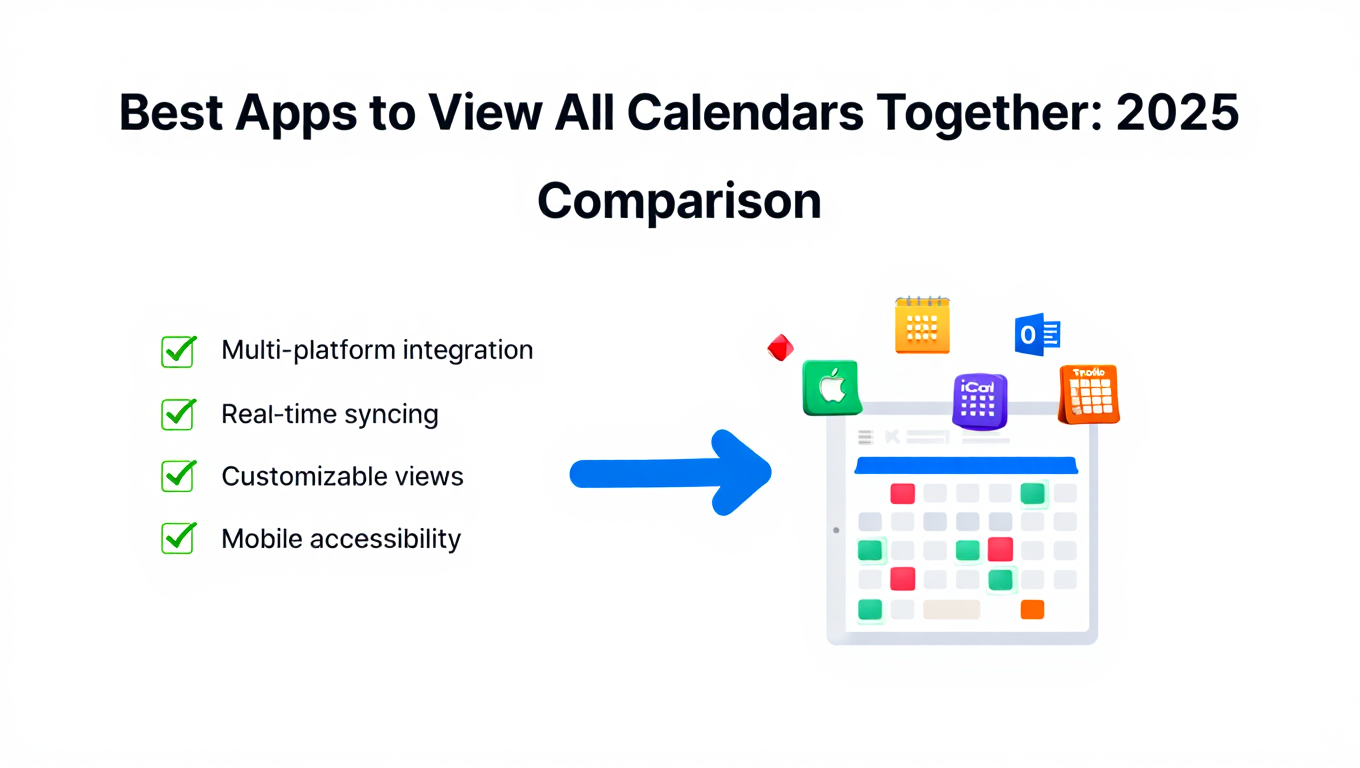
Best Apps to View All Calendars Together: 2025 Comparison
Compare the best apps and tools to view all calendars together. Detailed analysis of features, limits, pricing, and which solution fits your needs.
Best Calendar Aggregator Tools Ranked for 2025
Compare the top calendar aggregator tools in 2025. See which platforms offer unlimited connections, real-time sync, and true aggregation for professionals.
Best Calendar Consolidation App: Top 7 Solutions for 2025
Compare the best calendar consolidation apps of 2025. Find the perfect solution to merge work, personal, and team calendars into one unified view.