
 Google Calendar
  Outlook Calendar
  Google Meet
  Microsoft Teams
  Zoom Meetings
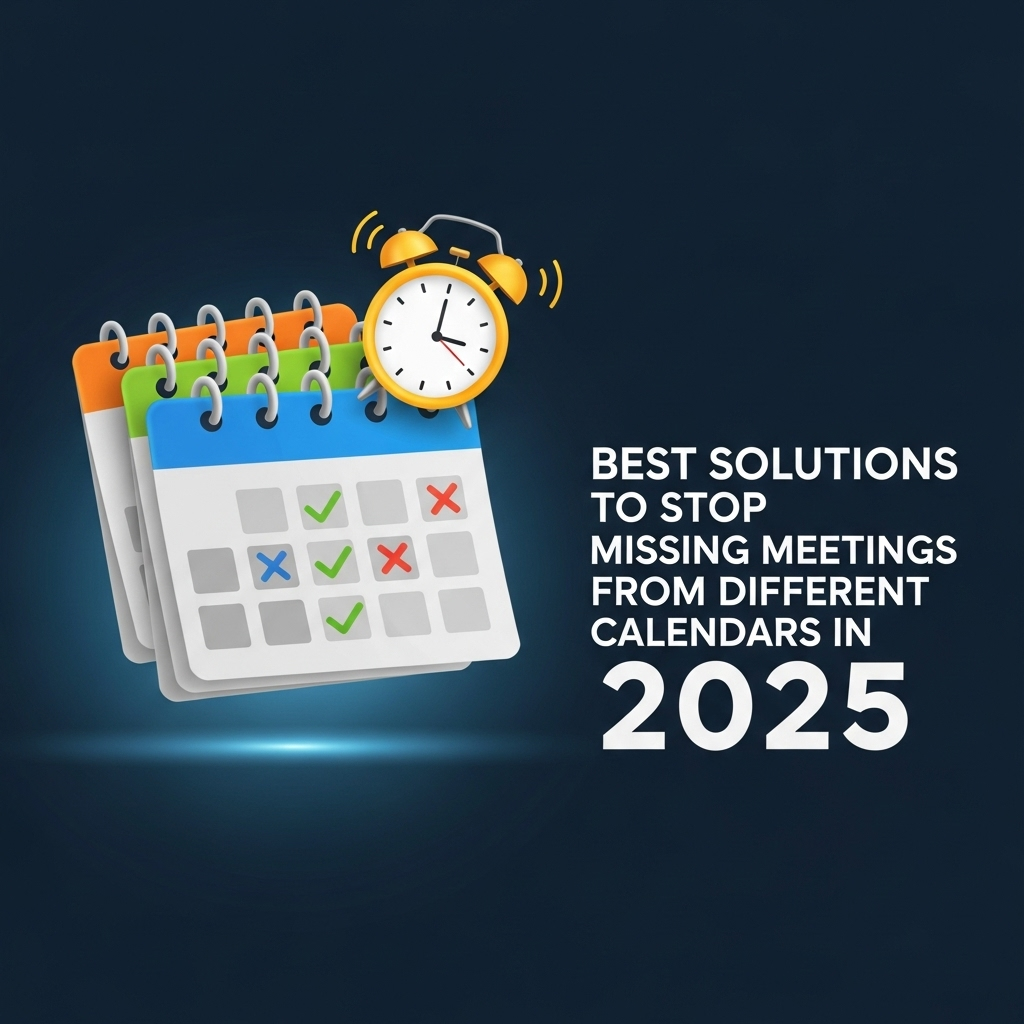
 Best Solutions to Stop Missing Meetings From Different Calendars in 2025
Compare proven solutions for calendar fragmentation. Discover which approach prevents missed meetings most effectively for your professional needs.
You have tried setting more reminders. You have attempted manual synchronization between calendar platforms. You have promised yourself you will be more careful about checking all your calendars before accepting new meetings. But you still occasionally miss meetings different calendars prevent you from seeing when you check the wrong system.
The problem is not lack of effort or discipline. The problem is that manual approaches cannot reliably solve a technical challenge. When your professional schedule spans multiple disconnected calendar platforms, human error is inevitable. You need a systematic solution that eliminates the fragmentation at its source.
Multiple approaches exist for solving calendar fragmentation, but they differ dramatically in effectiveness, reliability, and ease of use. Understanding these differences helps you choose the solution that will actually prevent missed meetings rather than just creating more complexity.
- Manual calendar checking across multiple platforms is unreliable and time-consuming
- Calendar import creates static copies that become outdated within hours
- One-way synchronization provides visibility but does not prevent conflicts
- Bidirectional sync keeps calendars aligned but adds complexity
- Unified calendar views solve the root problem by consolidating all calendars into a single interface
- AI-powered scheduling assistants automate meeting management but require platform support
Why Calendar Fragmentation is the Root Cause
Before evaluating solutions, you need to understand why people miss meetings different calendars create in the first place. The root cause is not forgetfulness or poor time management. The root cause is structural fragmentation.
Most professionals use at least three different calendar systems. You might have Google Calendar for personal appointments, Outlook for work meetings, and Apple Calendar synced to your mobile devices. Each platform maintains its own database of events. Without active synchronization or consolidation, they never communicate with each other.
This creates information silos. When you check Google Calendar and see that 2pm looks available, you are seeing incomplete information. Your Outlook calendar might show a work meeting at 2pm, but Google Calendar does not know that meeting exists. If you accept a personal appointment for 2pm based on what Google Calendar shows, you have created a conflict that neither platform warned you about.
Research confirms this pattern. About 1 in 8 employed Americans have missed meetings because of calendar mismanagement according to Statista, with remote workers being 30% more likely to experience problems than in-office employees. The difference stems directly from increased calendar complexity in remote work environments. Learn how to stop missing meetings with the right approach.
The visibility problem compounds when multiple people need to coordinate schedules. If your team uses different calendar platforms, finding meeting times that work for everyone requires manually checking multiple systems. This coordination overhead creates friction that leads to scheduling errors and missed meetings.
Solution 1: Manual Calendar Checking
The most basic approach is disciplined manual checking across all your calendar platforms before making any scheduling decisions.
How It Works
Before accepting any meeting invitation, you commit to opening each of your calendar applications and visually confirming that no conflicts exist. If you use three calendar platforms, you open all three, look at the proposed meeting time in each, and only accept the meeting if all three calendars show availability.
This approach requires no special tools or setup. You simply impose personal discipline on your scheduling workflow. Every scheduling decision involves multiple manual checks across platforms.
Advantages
Manual checking costs nothing beyond your time. It works with any calendar platforms regardless of compatibility or integration capabilities. You maintain complete control over the process and do not depend on third-party synchronization services that might fail.
For professionals who make very few scheduling decisions, perhaps one or two per week, manual checking might be sustainable. The overhead remains manageable when scheduling frequency is low.
Disadvantages
Manual checking is unreliable at scale. When you receive multiple meeting invitations daily, the discipline required to check all platforms every single time is difficult to maintain consistently. Eventually, you will be in a hurry, forget to check one platform, and create the conflict that causes you to miss meetings different calendars should have revealed.
The time cost becomes substantial for professionals with complex schedules. If you make ten scheduling decisions daily and spend two minutes checking multiple calendars for each decision, that is 20 minutes per day or nearly two hours per week spent on calendar checking. Over a year, this approaches 100 hours of pure overhead.
Manual checking also does not scale when others need to see your availability. If a colleague asks when you are free next week, you cannot send them a single calendar that shows your true availability. You either must manually compile information from multiple calendars or accept that they are seeing incomplete information.
Studies of human reliability in repetitive tasks show that error rates for manual checking procedures typically range from 3% to 5%. If you make 500 scheduling decisions annually and your manual checking failure rate is 4%, you will create approximately 20 scheduling conflicts per year that lead to missed or double-booked meetings.
Best Use Cases
Manual checking works only for professionals with very simple calendars who make infrequent scheduling decisions. If you have fewer than five meetings per week and use only two calendar platforms, manual discipline might be sustainable. For everyone else, manual checking guarantees that you will eventually miss meetings different calendars hide from view during rushed scheduling decisions.
Solution 2: Calendar Import and Export
Some calendar applications allow you to export events from one calendar and import them into another, creating copies of events across platforms.
How It Works
You periodically export your calendar from one platform as an ICS file and import that file into your other calendar platforms. This creates duplicate events, so your work calendar appears in your personal calendar and vice versa.
The export and import process requires manual execution. You might do this weekly or monthly, depending on how frequently your schedule changes and how diligent you are about maintenance.
Advantages
Calendar import provides better visibility than manual checking. After importing, you can see all your commitments in whichever calendar application you prefer to use. The technical complexity is minimal because export and import are standard features of most calendar applications.
This approach works with calendar platforms that do not support real-time synchronization. Even legacy calendar systems typically support ICS file export, making this a universal compatibility solution.
Disadvantages
The major flaw with import and export is that it creates static copies. The moment after you import your work calendar into your personal calendar, both calendars begin diverging. New meetings accepted in either platform do not appear in the other until you repeat the export and import process.
This lag time is where you miss meetings different calendars fail to reflect. If you import calendars on Monday and someone schedules a meeting for Thursday, you might accept a conflicting personal appointment on Wednesday because your personal calendar has not been updated since Monday. By the time you do your next import, the conflict exists but cannot be prevented.
The manual overhead of regular export and import is substantial. Setting aside time weekly or daily to manually move calendar data between platforms becomes another administrative burden that competes with actual productive work.
Calendar imports also create duplicates that must be managed. If you import your work calendar into your personal calendar and later update a meeting time in your work calendar, you now have a duplicate entry showing the old time in your personal calendar. Managing these duplicates becomes a significant maintenance challenge.
Best Use Cases
Calendar import is primarily useful for historical reference rather than active schedule management. If you want to see past meetings from multiple calendars in one place for record-keeping purposes, import creates that consolidated historical view. For preventing future missed meetings, import is too unreliable because of the inherent lag between imports.
Solution 3: One-Way Calendar Synchronization
One-way synchronization tools automatically copy events from a source calendar to a destination calendar, maintaining an ongoing connection that updates as changes occur.
How It Works
You configure a synchronization tool that monitors your source calendar and automatically creates corresponding events in your destination calendar. When a meeting is added to your source calendar, the sync tool detects the change and creates a matching event in your destination calendar within minutes.
Services like SyncGene, SyncThemCalendars, and various Zapier integrations provide one-way synchronization between popular calendar platforms including Google Calendar, Outlook, and iCloud.
Advantages
One-way sync eliminates the manual overhead of calendar import. Changes propagate automatically, typically within 5 to 15 minutes depending on the service. This dramatically reduces the lag time during which your calendars show different information.
The setup process is typically straightforward. You authenticate both calendar platforms, specify which calendar to sync from and which to sync to, configure what information to copy, and activate the synchronization. Ongoing maintenance is minimal because the service handles updates automatically.
One-way sync provides better visibility for preventing missed meetings different calendars would otherwise hide. If your work calendar syncs to your personal calendar, you can check your personal calendar and see both work and personal commitments together.
Disadvantages
The critical limitation of one-way synchronization is that it only flows information in a single direction. If your work calendar syncs to your personal calendar, you gain visibility into work commitments when checking your personal calendar. But you do not gain visibility into personal commitments when checking your work calendar.
This asymmetry means you still can miss meetings if you check the wrong calendar. If someone asks about your availability and you check your work calendar without remembering that your personal calendar has appointments that have not synced back, you will see incomplete availability information and potentially create conflicts.
One-way sync also creates a primary and secondary calendar dynamic. Events that originate in your source calendar appear in both places. Events that originate in your destination calendar only appear there. This confusion about which calendar is authoritative for which types of events leads to errors.
Calendar policies in some organizations prohibit syncing work calendar information to external platforms. If your work calendar cannot be synced outward for security reasons, one-way synchronization only provides partial solutions.
Best Use Cases
One-way synchronization works well when you have a clear primary calendar that you always check and a secondary calendar that you need visibility into. For example, if you primarily use Google Calendar and want to see your work Outlook events there, one-way sync from Outlook to Google gives you consolidated visibility.
The approach breaks down when you need true bidirectional visibility or when multiple people need to see your availability across platforms. One-way sync is better than manual checking but still allows you to miss meetings different calendars contain if you check the non-synced direction.
Solution 4: Bidirectional Calendar Synchronization
Bidirectional synchronization maintains two-way connections between calendar platforms, ensuring that changes in either calendar propagate to the other automatically.
How It Works
Bidirectional sync tools like OneCal, CalendarBridge, and advanced configurations of SyncGene monitor multiple calendars simultaneously. When an event is created, modified, or deleted in any connected calendar, the sync service propagates that change to all other connected calendars.
The synchronization is continuous. Within minutes of accepting a meeting in Outlook, that meeting appears in your Google Calendar. If you add a personal appointment to Google Calendar, it appears in Outlook shortly after. Both calendars stay aligned automatically.
Advantages
Bidirectional sync solves the primary calendar problem. No matter which calendar you check, you see the same complete schedule. This eliminates the root cause that leads people to miss meetings different calendars create when only one platform is visible during scheduling decisions.
The approach scales to multiple calendars. You can synchronize Google Calendar, Outlook, iCloud, and other platforms in a fully connected mesh where changes in any calendar propagate to all others. This provides consistent visibility regardless of which platform you or your colleagues are using.
Modern bidirectional sync services use native API connections rather than less reliable methods. They sync via Google Calendar API and Microsoft Graph API, ensuring compatibility with security policies and providing reliable real-time updates.
Configuration options let you control what information syncs. You might choose to sync only event times without titles for privacy, or sync complete event details for full transparency. These controls help address organizational policies about calendar data sharing.
- Sync Speed: Leading services propagate changes within 2-5 minutes of the original event modification
- Reliability: Modern API-based sync maintains 99%+ uptime with automatic error recovery
- Conflict Detection: Advanced services detect and alert you to scheduling conflicts before they cause missed meetings
- Multi-Platform Support: Connect 3+ calendar platforms simultaneously for complete schedule consolidation
Disadvantages
Bidirectional synchronization introduces technical complexity. Events exist in multiple calendars, and the sync service must maintain consistency while handling edge cases like modifications in multiple places simultaneously. When synchronization logic fails, you might experience duplicate events or missing changes.
Some organizations restrict bidirectional calendar sync because of security concerns about data flowing between work and personal systems. If company policy prohibits syncing work calendar data to external platforms, bidirectional sync cannot be implemented for your work calendar.
The service dependency creates a potential point of failure. If your synchronization service experiences downtime, your calendars stop updating and begin diverging. While this is rare with established services, the dependency means that calendar reliability depends on a third-party service staying operational.
Configuration complexity increases with the number of calendars. Setting up bidirectional sync between two calendars is straightforward. Synchronizing four or five calendars requires careful planning about which calendars sync to which others and what information flows in each connection.
Best Use Cases
Bidirectional synchronization is the most effective solution for professionals who must use multiple specific calendar platforms and cannot consolidate to a single platform. If your employer requires Outlook but you prefer Google Calendar for personal use, bidirectional sync keeps them aligned so you never miss meetings different calendars would otherwise hide.
The approach works well when you have established calendar ecosystems that you want to maintain while gaining unified visibility. You continue using your familiar platforms and applications, but the synchronization layer ensures they show consistent information.
Solution 5: Unified Calendar View Platforms
Unified calendar view platforms take a different architectural approach. Instead of synchronizing events between multiple calendars, they aggregate all your calendars into a single interface that displays everything together.
How It Works
You connect your various calendar platforms to a unified calendar service. The service maintains read access to all your calendars and presents them in a consolidated interface. When you view your schedule, you see events from all connected calendars displayed together as if they were a single calendar.
Changes you make in the unified interface propagate back to the original calendar platforms. If you accept a meeting while viewing your unified calendar, the event gets created in the appropriate source calendar automatically.
CalendHub.com provides exactly this unified calendar experience, displaying Google Calendar, Outlook, iCloud, and other calendars in a single, familiar interface that eliminates calendar fragmentation while maintaining compatibility with all your existing platforms. Compare the best calendar aggregator tools to find the right solution.
Advantages
Unified calendar views solve the visibility problem completely. You never check the wrong calendar because there is only one calendar to check. All your commitments appear together regardless of which platform originally created them, making it impossible to miss meetings different calendars would hide if viewed separately.
The approach does not require changes to your existing calendar platforms. You continue using Google Calendar, Outlook, iCloud, or whatever platforms your work and personal needs require. The unified view sits on top, providing consolidation without forcing platform migration.
Unified calendar platforms typically offer enhanced features beyond simple consolidation. Advanced search across all calendars, intelligent conflict detection, availability summaries, and scheduling assistants that work across multiple platforms provide capabilities that individual calendar applications cannot match.
The architecture scales elegantly. Adding another calendar to your unified view is simple. Connect it through the platform, and events from that calendar start appearing in your consolidated view immediately. There is no complex synchronization configuration or management of bidirectional sync relationships.
Conflict detection becomes automatic. Because the unified platform sees all your calendars simultaneously, it can detect and warn about conflicts before they cause you to miss meetings. If you try to accept a meeting that conflicts with an appointment in a different calendar, the unified platform alerts you immediately.
Disadvantages
Unified calendar platforms require that you use their interface for primary calendar viewing. If you are deeply attached to a specific calendar application's interface or features, the transition to a unified platform interface requires adjustment.
The service dependency is similar to bidirectional sync. Your calendar access depends on the unified platform staying operational. While leading platforms maintain high reliability, you are adding a layer between yourself and your calendars.
Some unified platforms charge subscription fees for advanced features or large numbers of connected calendars. While basic unified views might be free, professional use cases often require paid tiers.
Mobile applications matter for unified calendar platforms. If the platform does not offer mobile apps or if their mobile experience is subpar, you lose the unified view when scheduling from your phone. This reintroduces fragmentation in mobile contexts unless the mobile app is excellent.
Need better calendar management? CalendHub unifies all your calendars with smart scheduling and video conferencing.
Best Use Cases
Unified calendar views are the optimal solution for professionals with complex, multi-platform calendar ecosystems who need reliable prevention of missed meetings different calendars create. If you use three or more calendar platforms and schedule multiple meetings daily, unified views provide the most robust protection.
The approach is especially valuable for remote workers who cannot rely on physical office environmental cues to remember meetings. When your calendar is your only source of truth about commitments, having a unified view that shows everything simultaneously is essential.
Unified calendar platforms also excel when multiple people need visibility into your availability. You can share your unified calendar view, giving colleagues accurate availability information that reflects all your commitments regardless of platform, preventing the scheduling conflicts that lead to missed meetings.
Solution 6: AI-Powered Scheduling Assistants
The newest category of calendar management tools uses artificial intelligence to automate scheduling tasks, predict conflicts, and optimize meeting arrangements across multiple calendars.
How It Works
AI scheduling assistants connect to your calendar platforms and analyze your scheduling patterns, meeting habits, and preferences. They can automatically handle scheduling requests, suggest optimal meeting times, detect potential conflicts, and even reschedule meetings when conflicts arise.
Tools like Clockwise, Reclaim.ai, and integrated AI features in platforms like ClickUp use machine learning to understand your schedule and make intelligent scheduling decisions on your behalf.
Advanced AI assistants can communicate with meeting participants, negotiate meeting times, handle rescheduling, and update all relevant calendars automatically. The goal is to reduce or eliminate manual calendar management entirely.
Advantages
AI scheduling assistants provide the highest level of automation. They can prevent you from missing meetings different calendars create by handling the entire scheduling workflow automatically. The assistant sees all your calendars, understands conflicts, and only accepts meetings that actually fit your schedule.
The learning capability improves over time. As the AI assistant observes your scheduling behavior, it learns your preferences about meeting times, buffer requirements, and scheduling priorities. This personalization makes the assistant increasingly effective at managing your calendar in ways that match your needs.
Proactive conflict prevention is a key strength. AI assistants can identify potential conflicts days or weeks in advance and automatically suggest or implement solutions before conflicts cause missed meetings. This forward-looking approach prevents problems rather than just detecting them at the last moment.
Integration with communication tools lets AI assistants handle scheduling negotiations autonomously. If someone emails requesting a meeting, the AI can respond with available times, send calendar invitations, and confirm the meeting without any manual intervention.
Disadvantages
AI scheduling requires platform support and permissions. The assistant needs deep integration with your calendar platforms, email systems, and potentially your organization's other tools. This integration might not be possible in all organizational environments, especially those with strict security requirements.
Trust in autonomous scheduling decisions develops slowly. Initially, you might feel uncomfortable letting an AI system accept or decline meetings on your behalf. Building confidence that the AI makes appropriate decisions takes time and careful monitoring.
The cost for enterprise-grade AI scheduling assistants can be substantial. While basic features might be affordable, advanced AI capabilities often require premium subscriptions that cost significantly more than simpler synchronization or unified view solutions.
AI scheduling assistants work best when all meeting participants use compatible systems. If you use an AI assistant but your colleagues do not, the coordination still requires manual intervention, limiting the automation benefits.
Current AI scheduling technology still has limitations in understanding context and nuance. An AI might not recognize that a casual coffee meeting can be scheduled over lunch while a formal client presentation cannot, leading to inappropriate scheduling decisions that require manual correction.
Best Use Cases
AI scheduling assistants provide the most value for executives and professionals who schedule dozens of meetings weekly and have assistants or teams managing their calendars. The automation justifies the cost and complexity when calendar management would otherwise consume substantial human time.
For professionals with complex scheduling constraints and priorities, AI assistants can optimize calendar arrangements in ways that manual management cannot match. If you need to balance focused work time, collaborative meetings, and external commitments, AI optimization can create better schedules than humans typically achieve through manual arrangement.
Comparing Solutions: Which Prevents Missed Meetings Most Effectively
The solutions vary dramatically in how reliably they prevent you from missing meetings different calendars create. Comparing them across key dimensions reveals which approaches actually solve the problem.
Reliability Comparison
Manual checking is the least reliable solution. Human error guarantees eventual failures when you check the wrong calendar or skip a platform during a rushed scheduling decision.
Calendar import and export ranks second-lowest. The lag between imports creates windows where your calendars show different information, leading to conflicts.
One-way synchronization is more reliable than manual approaches but still allows failures when you check the non-synced direction.
Bidirectional synchronization provides high reliability by keeping calendars aligned, but sync failures or delays can still allow conflicts to develop.
Unified calendar views offer the highest reliability. Because you always view all calendars together, conflicts are immediately visible and cannot result from checking the wrong platform.
AI scheduling assistants provide very high reliability when they work correctly, but their complexity introduces more potential failure modes than simpler unified view approaches.
Based on ability to reliably prevent missed meetings different calendars create:
- Unified Calendar Views - Eliminates root cause by consolidating all calendars into single interface
- AI Scheduling Assistants - Automates prevention but adds complexity
- Bidirectional Synchronization - Keeps calendars aligned but depends on sync reliability
- One-Way Synchronization - Provides partial visibility in one direction
- Calendar Import/Export - Creates static copies that quickly become outdated
- Manual Checking - Relies on human discipline that eventually fails
Ease of Use Comparison
Manual checking requires no setup but imposes ongoing effort for every scheduling decision. The cognitive load and time cost make it impractical for complex schedules.
Calendar import and export setup is simple but requires regular manual execution that becomes burdensome.
One-way synchronization setup is straightforward with modern tools. Ongoing use is mostly automatic once configured.
Bidirectional synchronization requires more careful setup, especially with multiple calendars, but becomes automatic after initial configuration.
Unified calendar views typically offer the best balance. Initial setup involves connecting your calendars, which takes 15-30 minutes, and then daily use is simpler than any other approach because you only check one interface.
AI scheduling assistants have the most complex setup and require training periods where you monitor and correct the AI's decisions before trusting full automation.
Cost Comparison
Manual checking costs only time, making it the cheapest monetary option but potentially the most expensive in terms of opportunity cost from time spent on calendar management.
Calendar import and export is free using built-in calendar features.
One-way synchronization ranges from free for basic services to $5-15 monthly for premium features.
Bidirectional synchronization typically costs $10-30 monthly depending on the number of calendars and features.
Unified calendar view platforms range from free basic tiers to $15-50 monthly for professional features and unlimited calendars.
AI scheduling assistants are the most expensive, often costing $30-100+ monthly for enterprise features.
When evaluating cost, consider the value of prevented missed meetings. If preventing one missed client meeting per year preserves a $50,000 relationship, even expensive calendar solutions deliver enormous return on investment.
Scalability Comparison
Manual checking does not scale. As your schedule becomes more complex and you use more calendars, manual checking becomes increasingly unreliable.
Calendar import and export scales poorly because maintenance overhead increases with each additional calendar.
One-way synchronization scales moderately. You can sync multiple source calendars to a single destination, but the asymmetry creates complexity.
Bidirectional synchronization scales well technically but configuration complexity increases with each additional calendar.
Unified calendar views scale excellently. Adding calendars to your unified view is simple, and the interface handles displaying many calendars together effectively.
AI scheduling assistants scale well once properly configured, handling increased meeting volume automatically.
Implementation Strategies for Each Solution
Choosing a solution is only the first step. Effective implementation determines whether the solution actually prevents you from missing meetings different calendars would otherwise hide.
Implementing Unified Calendar Views
Start by auditing all your current calendar platforms. List each calendar system you use, what types of events go into each calendar, and who else has access to each calendar.
Research unified calendar view platforms that support all your current calendars. CalendHub.com supports Google Calendar, Outlook, iCloud, and other major platforms, making it compatible with most professional calendar ecosystems.
Connect your calendars one at a time. Start with your primary work calendar, verify it displays correctly in the unified view, then add personal calendars and other secondary calendars. Test that events appear correctly and that changes sync bidirectionally.
Configure your view preferences. Set up color coding to distinguish events from different source calendars. Configure which calendars display by default and which you toggle on when needed. Customize notification settings to ensure you receive appropriate reminders.
Train yourself to use the unified view as your primary calendar interface. Bookmark it in your browser. Set it as your homepage. Install the mobile app if available. The unified view only prevents missed meetings different calendars create if you actually use it for all scheduling decisions.
Gradually shift all calendar checking and management to the unified platform. When someone asks about your availability, check the unified view. When you need to schedule something, use the unified interface. Within two weeks, the new habit should become automatic.
Implementing Bidirectional Synchronization
If unified views are not suitable for your situation, bidirectional synchronization offers the next-best alternative.
Choose a synchronization service that supports all your calendar platforms with native API connections. Services using native APIs are more reliable than those using less direct integration methods.
Plan your synchronization architecture. Decide which calendars need to sync to which others. The simplest approach is a hub-and-spoke model where one primary calendar syncs bidirectionally with all others. More complex scenarios might require mesh synchronization where every calendar syncs to every other calendar.
Configure synchronization settings carefully. Decide what event information syncs. For work calendars, you might sync only busy/free status without event titles for privacy. For personal calendars, you might sync complete event details.
Test thoroughly before relying on the synchronization. Create test events in each calendar and verify they appear in all synchronized calendars within the expected timeframe. Modify test events and confirm changes propagate. Delete test events and verify deletions sync correctly.
Set up monitoring to detect synchronization failures. Check weekly that your calendars remain aligned. Some synchronization services offer sync health reports that alert you to failures.
Implementing AI Scheduling Assistants
AI scheduling assistants require the most complex implementation but offer the highest automation potential.
Start with a thorough onboarding process. Most AI scheduling tools require you to train them on your preferences, scheduling constraints, and priorities. Invest time in this initial training to improve accuracy.
Begin with monitoring mode if available. Let the AI suggest scheduling decisions but require your approval before it takes actions. This lets you correct mistakes and refine the AI's understanding while preventing errors from causing missed meetings.
Gradually increase autonomy as the AI demonstrates reliability. Start by letting it handle low-stakes scheduling like internal team meetings. As confidence builds, expand to external meetings and more important commitments.
Maintain oversight indefinitely. Even well-trained AI scheduling assistants make occasional mistakes. Regular spot-checks of your calendar ensure the AI is not creating conflicts or making inappropriate scheduling decisions that could cause you to miss meetings.
Combining Solutions for Maximum Reliability
The most robust approach often combines multiple solutions to create layered protection against missing meetings different calendars create.
For example, you might implement unified calendar views as your primary solution, providing consolidated visibility across all platforms. You could supplement this with bidirectional synchronization that keeps your underlying calendar platforms aligned, ensuring that colleagues checking your native calendars see accurate information even when they do not access your unified view.
Adding AI-powered conflict detection provides another protection layer. Even if you somehow create a scheduling conflict through the unified view, AI analysis can detect and alert you before the conflict causes missed meetings.
The key principle is defense in depth. Each protection layer catches errors that might slip through other layers. While this increases complexity and cost, the resulting reliability might be worth the investment for professionals where missing meetings has severe career consequences.
Choosing the Right Solution for Your Situation
The optimal solution depends on your specific circumstances, calendar complexity, organizational constraints, and budget.
Choose manual checking only if you have a very simple schedule with fewer than five meetings weekly and use only two calendar platforms. For everyone else, manual approaches cannot reliably prevent missed meetings different calendars create.
Choose calendar import/export if you need historical consolidation for record-keeping but do not need active prevention of future conflicts.
Choose one-way synchronization if you have a clear primary calendar and just need to see events from secondary calendars for awareness without full bidirectional sync.
Choose bidirectional synchronization if organizational policies prevent using unified calendar platforms but you can implement synchronization between approved calendar systems.
Choose unified calendar views if you need the most reliable prevention of missed meetings, use multiple calendar platforms, and want a simple interface that consolidates everything. This is the optimal choice for most professionals with complex schedules.
CalendHub.com provides professional-grade unified calendar management that eliminates calendar fragmentation by displaying all your calendars in a single, easy-to-use interface. This architectural approach solves the root cause that leads people to miss meetings different calendars create when viewed separately. Avoid the common causes of double bookings with proper calendar integration.
Choose AI scheduling assistants if you schedule dozens of meetings weekly, have complex scheduling constraints, and can justify premium pricing for automation that saves substantial time.
Common Implementation Mistakes to Avoid
Even good solutions fail if implemented poorly. Avoid these common mistakes that allow professionals to continue missing meetings different calendars should prevent.
Mistake 1: Incomplete Calendar Coverage
The most common failure is implementing a solution but not connecting all your calendars. If you set up unified calendar viewing but forget to connect your secondary personal calendar, events from that calendar remain invisible, and you will still miss meetings it contains.
Audit thoroughly. Find every calendar platform you use, including calendars you rarely check. Connect them all to your chosen solution. Incomplete coverage leaves gaps where conflicts can hide.
Mistake 2: Not Changing Habits
Implementing calendar consolidation technology does not help if you continue checking individual calendar platforms out of habit. The solution only prevents missed meetings different calendars create if you actually use the consolidated view for all scheduling decisions.
Actively build new habits. Remove bookmarks to individual calendar platforms. Train yourself to check only the unified view. Set calendar defaults on all devices to your consolidated calendar interface.
Mistake 3: Ignoring Mobile Devices
Many professionals implement excellent calendar consolidation on their computers but forget about mobile devices. When you receive a meeting invitation on your phone, do you see your complete schedule, or are you viewing a single calendar platform?
Ensure your calendar solution works seamlessly across all devices. Install mobile apps that provide the same unified view you have on your computer. Configure email clients on mobile devices to open calendar invitations in your unified calendar application rather than native platform calendars.
Mistake 4: Not Verifying Synchronization
If you implement synchronization-based solutions, you must verify regularly that synchronization is working. Sync connections can break silently, and you might not realize your calendars have stopped updating until you miss meetings different calendars would show if they were properly synchronized.
Schedule weekly verification checks. Create a test event in one calendar and confirm it appears in synchronized calendars. This proactive monitoring catches synchronization failures before they cause real problems.
Mistake 5: Overcomplicating the Solution
Some professionals implement overly complex calendar architectures with multiple synchronization services, numerous unified views, and elaborate automation workflows. This complexity creates its own maintenance burden and introduces more potential failure points.
Start simple. Choose one primary solution and implement it thoroughly. Add complexity only when clear needs emerge. The goal is to prevent missed meetings, not to build elaborate calendar infrastructure for its own sake.
The Future of Calendar Management Solutions
Calendar management technology continues to evolve rapidly. Understanding emerging trends helps you choose solutions that will remain effective as professional work continues to change.
The clear trend is toward unified experiences rather than point-to-point synchronization. The industry is moving away from trying to keep multiple disparate calendar platforms aligned through synchronization, instead creating abstraction layers that provide single interfaces above multiple calendars.
This architectural shift matches how other technology problems have been solved. Rather than trying to make incompatible systems work together, successful solutions create unified experiences that work regardless of underlying platform diversity.
AI integration is accelerating across all calendar management approaches. Within the next few years, even basic calendar platforms will include AI features that predict conflicts, suggest optimal meeting times, and automate routine scheduling tasks. These AI capabilities will make it even easier to prevent missing meetings different calendars might otherwise hide.
Voice interface integration is emerging as calendar platforms add support for smart speakers and voice assistants. Asking your voice assistant about schedule conflicts or accepting meetings via voice commands will become standard, requiring calendar solutions that work seamlessly with voice interaction.
Workplace collaboration platforms are absorbing calendar functionality. Tools like Slack, Microsoft Teams, and others are integrating scheduling features directly into their interfaces, potentially creating new calendar fragmentation as another calendar platform enters professional workflows. Unified calendar solutions that can aggregate these new calendar sources will become increasingly valuable.
Taking Action to Stop Missing Meetings
You now understand why professionals miss meetings different calendars create, the range of available solutions, and how to evaluate which approach best fits your needs. The remaining step is implementation.
Start with honest assessment of your current situation. How many calendars do you use? How frequently do you make scheduling decisions? Have you missed important meetings due to calendar fragmentation? What did those missed meetings cost you in terms of reputation, opportunities, or actual financial impact?
Based on that assessment, choose your solution. For most professionals with complex schedules spanning multiple calendar platforms, unified calendar views provide the most reliable and user-friendly prevention of missed meetings. CalendHub.com delivers this unified experience with professional-grade calendar consolidation across all major platforms.
- Week 1: Audit all your calendar platforms and document what you currently use
- Week 2: Research and choose the calendar consolidation solution that fits your needs and constraints
- Week 3: Implement your chosen solution by connecting all your calendars and configuring settings
- Week 4: Build new habits by shifting all calendar checking to your unified interface
- Ongoing: Monitor effectiveness weekly and verify that you are not missing meetings or experiencing scheduling conflicts
The professionals who advance in their careers are those who master fundamentals while leveraging technology to eliminate preventable failures. Calendar management is fundamental. The technology to eliminate calendar fragmentation exists today and is widely accessible.
Your calendar is too important to leave to chance. Missing meetings damages your professional reputation, costs real career opportunities, and wastes enormous amounts of time in recovery and rescheduling. These costs are entirely preventable with the right calendar consolidation approach.
The question is not whether you can afford to implement a proper calendar management solution. The question is whether you can afford not to. The next meeting you miss different calendars prevent you from seeing might be the one that costs you your next promotion, your best client relationship, or your reputation for reliability.
Choose your solution. Implement it properly. Build the habits that ensure you use it consistently. Never miss another meeting because of calendar fragmentation. Your career depends on showing up when it matters.
Ready to Simplify Your Schedule?
Join thousands of professionals who have unified their calendars and reclaimed their time with CalendHub's intelligent scheduling platform.
Related Articles
The Hidden Cost of Missing Meetings Due to Different Calendars in 2025
Discover the career and financial damage caused by missed meetings from calendar fragmentation. Real stories and statistics reveal the true professional cost.
Fix Calendar Chaos Multiple Accounts: Complete 2025 Recovery Guide
End calendar chaos from multiple accounts with this proven system. Transform your overwhelming schedule into an organized, stress-free calendar in under an hour.

Too Many Calendars to Check: How 5 People Solved This Daily Struggle
Real stories from professionals who stopped checking multiple calendars. Discover their before/after routines and how they reclaimed hours every week.