
 Google Calendar
  Outlook Calendar
  Google Meet
  Microsoft Teams
  Zoom Meetings
 CalendHub vs Reclaim AI: Which Calendar Tool Wins in 2025?
Compare CalendHub and Reclaim AI for calendar management. Smart scheduling vs multi-calendar unification for busy professionals.
Reclaim AI has become one of the most talked-about calendar tools for teams that run on Google Workspace. It intelligently defends your focus time, auto-schedules habits, and finds optimal meeting slots across team members. If you live inside Google Calendar, Reclaim can feel like magic. But here's the catch. Not everyone lives inside Google Calendar. And for professionals juggling calendars across multiple platforms and organizations, Reclaim's Google-first approach leaves serious gaps.
That's the tension at the heart of the CalendHub vs Reclaim AI comparison. Reclaim optimizes one calendar ecosystem beautifully. CalendHub.com unifies all your calendar ecosystems into a single view. If your calendar life extends beyond Google, this distinction matters more than any AI feature. Let's dig into what each tool does best and where each one falls short.
- CalendHub strength Unlimited cross-platform calendar unification with Google, Outlook, iCloud, and Exchange
- Reclaim AI strength Intelligent habit scheduling and focus time protection within Google Calendar
- Best for multi-calendar power users CalendHub
- Best for Google Calendar teams wanting AI optimization Reclaim AI
CalendHub vs Reclaim AI at a Glance
| Feature | CalendHub | Reclaim AI |
|---|---|---|
| Calendar connections | Unlimited, cross-platform | Primarily Google Calendar |
| Outlook support | Full native support | Limited, secondary |
| iCloud/Exchange support | Yes | No |
| AI scheduling | No | Yes, core feature |
| Habit scheduling | No | Yes |
| Focus time protection | No | Yes, automatic |
| Unified multi-platform view | Yes | No |
| Conflict detection | Real-time across all calendars | Within Google ecosystem |
| Free tier | No | Yes, limited features |
| Pricing | $9.99/mo | Free / $10-15/mo |
Where CalendHub Wins
Platform-agnostic calendar unification. This is the dealbreaker for many professionals. Reclaim AI is built primarily for Google Calendar. If your work spans Google Workspace, Microsoft 365, iCloud, and Exchange, Reclaim can't bring all of those together. CalendHub connects to every major calendar platform and shows them all in one unified view. No platform left behind.
Unlimited calendar connections. Whether you manage 5 calendars or 25, CalendHub doesn't impose limits. Reclaim's free tier restricts certain features, and its overall architecture is designed for optimizing a smaller number of calendars within Google's ecosystem rather than aggregating dozens of accounts across platforms.
No algorithmic surprises. Reclaim's AI automatically adjusts your schedule, moving habits, buffer times, and flexible holds around as new meetings come in. For some workflows, that's fantastic. But for fractional executives and consultants with carefully negotiated meeting times across multiple client organizations, algorithmic schedule changes can create confusion. CalendHub shows you everything and lets you decide. You maintain full control.
True cross-organization visibility. Imagine working with four different companies. Two use Google Workspace, one uses Microsoft 365, and one uses an on-premise Exchange server. CalendHub pulls every calendar from every organization into a single dashboard. Reclaim simply wasn't designed for this scenario. You can learn more about managing this kind of complexity in our guide to the best calendar consolidation apps for 2025.
Where Reclaim AI Has Strengths
Reclaim deserves genuine credit for what it does within its focus area.
Smart habit scheduling is genuinely useful. Tell Reclaim you want to exercise at lunch three times a week, and it'll find the right slots automatically. It treats habits as flexible events that yield to higher-priority meetings but fight for their spot when possible. This kind of intelligent time management is something most calendar tools don't even attempt.
Focus time protection works well. Reclaim automatically blocks chunks of deep work time on your calendar and defends them against meeting requests. It learns your patterns and preferences over time. For knowledge workers battling meeting overload, this feature alone can reclaim hours of productive time each week.
Solid free tier. Reclaim offers a genuinely useful free plan that includes basic AI scheduling, calendar sync, and habit tracking. If you're testing the waters with AI calendar management and your world revolves around Google Calendar, the free tier is a low-risk starting point.
Team scheduling intelligence. For teams using Google Workspace, Reclaim can optimize meeting times across multiple team members while protecting everyone's focus time. The "smart meetings" feature finds the best available slot for all participants and automatically reschedules if conflicts arise.
Calendar Management Comparison
The philosophical difference here is important to understand.
Need better calendar management? CalendHub unifies all your calendars with smart scheduling and video conferencing.
Reclaim AI sees your calendar as something to be optimized. It assumes you have one primary calendar (Google) and wants to make that calendar as productive as possible through intelligent scheduling, habit automation, and focus time defense.
CalendHub sees your calendar landscape as something to be unified. It assumes you have many calendars across many platforms and wants to bring them all together so you never miss an event, never double-book, and never waste time switching between apps.
These are fundamentally different goals. For a software developer at a Google Workspace company who wants to protect deep coding time, Reclaim is arguably the better tool. For a consultant managing eight client calendars across four different platforms, CalendHub solves a problem Reclaim doesn't even address.
The Google Calendar dependency is worth emphasizing. If your primary client switches from Google Workspace to Microsoft 365, or if you take on a new engagement with a company running Exchange, Reclaim's value proposition weakens significantly. CalendHub.com remains equally effective regardless of which platforms your various organizations use.
If you're exploring tools specifically because you've hit calendar connection limits with other platforms, our comparison of Calendly alternatives with unlimited calendar support provides additional context.
Pricing Comparison
Both tools are reasonably priced, but their value propositions differ.
Reclaim AI offers a free tier with basic features. The Starter plan runs around $10 per month, and the Business plan costs approximately $15 per month per user. The free tier is genuinely functional, making it easy to test before committing. Team pricing scales per user, which can add up for larger organizations.
CalendHub costs $9.99 per month with unlimited calendar connections, cross-platform unification, real-time conflict detection, and full-featured mobile apps. There's no free tier, but the single price point includes everything without feature gates.
For an individual Google Calendar user, Reclaim's free tier is hard to beat on price. You get AI scheduling at no cost. But the moment you need Outlook, iCloud, or Exchange support, or the moment your calendar count exceeds what Reclaim handles comfortably, CalendHub's $9.99 provides better value for multi-calendar scenarios.
For teams, Reclaim's per-user pricing at $10-15 per month per person can escalate quickly. A team of 10 on the Business plan would pay $150 per month. CalendHub's flat pricing structure offers predictability that per-user models can't match.
Which Should You Choose?
Choose CalendHub if your calendar life spans multiple platforms and organizations. If you're a fractional executive, multi-company consultant, or portfolio professional managing calendars across Google, Outlook, iCloud, and Exchange, CalendHub solves your actual problem. You need visibility across everything, not AI optimization within one ecosystem. At $9.99 per month through CalendHub.com, it's built specifically for this use case.
Choose Reclaim AI if your entire professional life runs on Google Calendar and you want AI to help you work smarter within that ecosystem. If focus time protection, habit scheduling, and smart meeting optimization are your priorities, and you don't need cross-platform calendar aggregation, Reclaim delivers genuine value.
Think twice about Reclaim if you have significant calendar commitments outside of Google's ecosystem. The limited Outlook support and absent iCloud/Exchange integration mean you'll still have blind spots in your schedule visibility. Those blind spots lead to double-bookings and missed meetings.
For more guidance on choosing the right tool for complex calendar setups, check out our roundup of the best scheduling software with multiple calendar support.
Conclusion
Reclaim AI is a genuinely innovative tool that makes Google Calendar smarter. Its habit scheduling, focus time protection, and team optimization features represent some of the best AI-driven calendar management available today. For Google-centric teams, it's a strong choice.
But the calendar management landscape in 2025 is more fragmented than ever. Professionals increasingly work across multiple organizations, each with its own calendar platform. In that reality, a tool that only optimizes one ecosystem leaves you managing the rest manually.
CalendHub takes the broader view. Instead of making one calendar smarter, it makes all your calendars visible. For power users who need to see everything in one place without platform restrictions, that unified approach delivers more daily value than any AI scheduling feature. The right tool depends on your situation, but for multi-calendar professionals, CalendHub wins this comparison.
Ready to Simplify Your Schedule?
Join thousands of professionals who have unified their calendars and reclaimed their time with CalendHub's intelligent scheduling platform.
Related Articles
Best Apps to View All Calendars in One Place (2025 Review)
Compare the top apps for viewing all calendars in one place. Detailed reviews of features, limits, and pricing to help you choose the right solution.
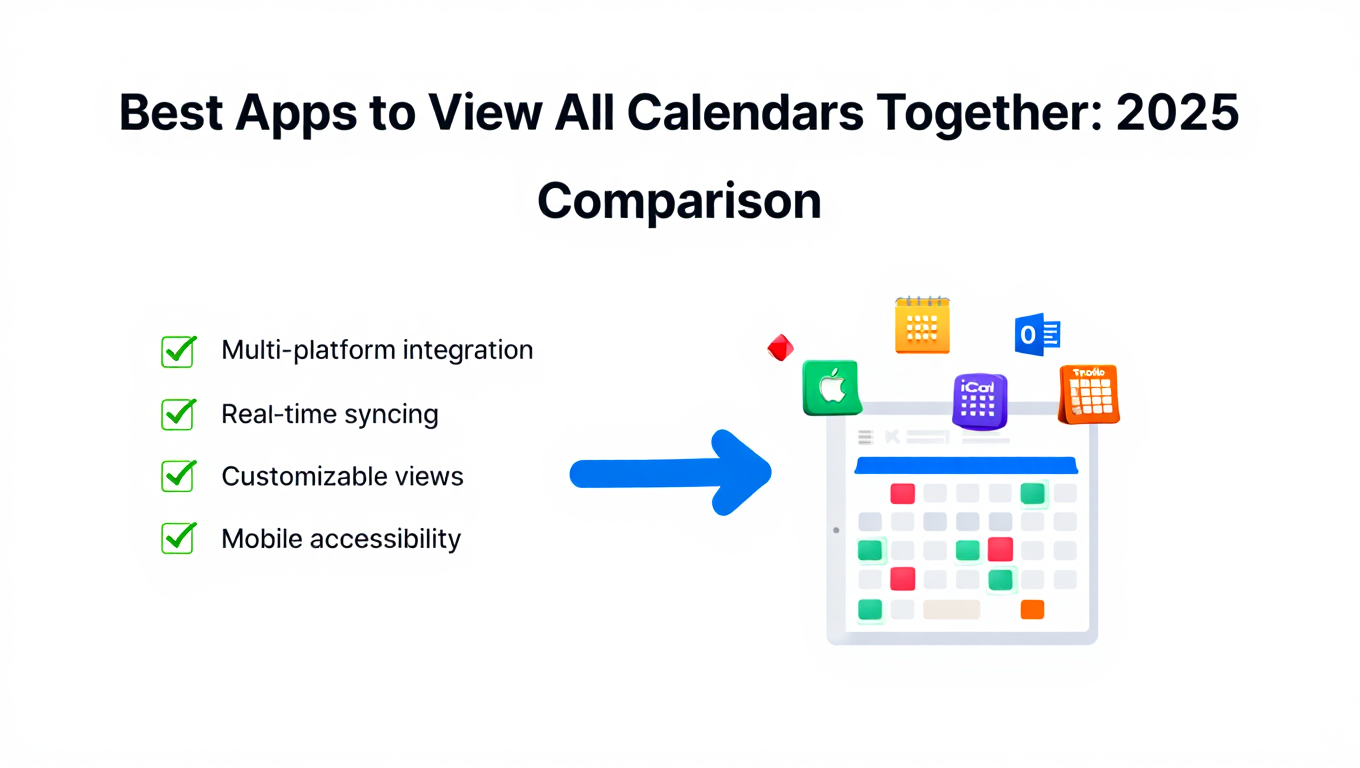
Best Apps to View All Calendars Together: 2025 Comparison
Compare the best apps and tools to view all calendars together. Detailed analysis of features, limits, pricing, and which solution fits your needs.
Best Calendar Aggregator Tools Ranked for 2025
Compare the top calendar aggregator tools in 2025. See which platforms offer unlimited connections, real-time sync, and true aggregation for professionals.